Do 82% of AI Citations Come From Third-Party Sites?
· Published August 4, 2026 · Updated October 16, 2026 · 4 min read
The figure as commonly quoted: 82% of AI citations come from third-party sites, therefore your own content is a minor input into AI answers.
The measurement is careful and the author’s own framing is more careful still. The quoted sentence describes a different metric from the one she reported.
What the source actually measured
Aleyda Solis published a cross-vertical analysis on August 2, 2026.
| Publisher | Aleyda Solis |
| Date | August 2, 2026 |
| Sample | 15 leading brands in each of SaaS, ecommerce and finance, 45 brands in total |
| Data source | Semrush Enterprise |
| Surfaces | Google AI Mode, Gemini, ChatGPT |
The owned versus external split she reports, as the mention-weighted share of the top cited source domains: SaaS 17.7% owned and 82.3% external, ecommerce 30.4% and 69.6%, finance 20.6% and 79.4%.
The method is the part that matters. She took the top 10 cited source domains per brand, roughly 150 top source slots per vertical, and hand-classified each domain. The shares in her table weight those domains by mentions. They describe the source mix behind the top 10 domains per brand. They do not count all AI citations.
Where the quoted version and the source diverge
The 69.6% to 82.3% figure is the mention-weighted share of the top 10 cited source domains per brand. Quoting it as “82% of AI citations are third-party” changes the metric. Ten domains per brand leave out the long tail of cited pages, so the figure cannot describe all citations.
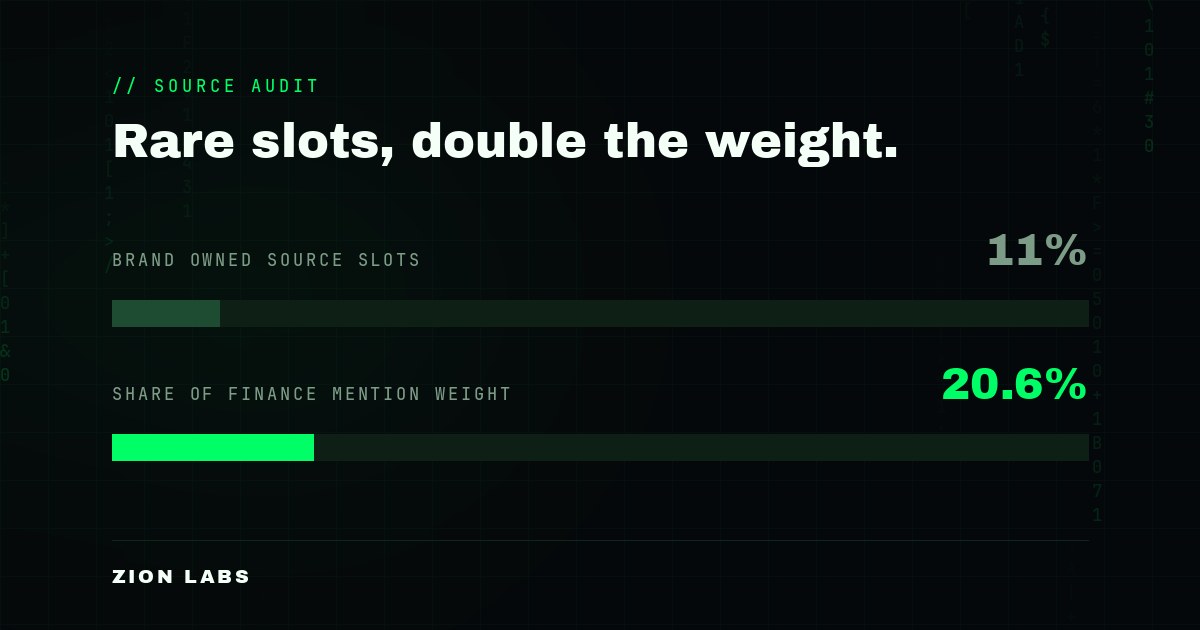
The slot count is a separate number, and Solis reports it separately. Brand-owned domains are mention-dense but slot-scarce. They hold only about 10% to 11% of the 150 top source slots in each vertical, yet carry a larger share of the mention weight: 20.6% in finance from about 10% of slots, with similarly disproportionate shares in SaaS and ecommerce. Her table puts owned mention weight at 17.7% in SaaS, 30.4% in ecommerce and 20.6% in finance. In all three verticals owned domains carry more than their slot share.
The method explains part of the gap. Capping at the top 10 domains per brand limits how much any single domain can occupy. A brand usually holds one of its own ten slots, so the owned slot share sits near 10%, and the measured 10% to 11% means owned domains are at or close to that level almost everywhere. A domain type that carries more than its slot share in mentions is a concentrated asset.
Her own framing is more careful than the industry’s use of it. The title calls AI search a third-party citation problem with an on-page corroboration base, and the second half is load-bearing. Her stated caveats are among the best in this literature: domain-level citation data cannot establish sponsorship or promoted distribution, the data represents source-environment associations rather than campaign attribution, and you cannot responsibly guarantee or buy an organic AI citation.
One unresolved thing
In fairness to anyone using her data, there is a loose end. A separate post of hers on SaaS brands reports external share of citation weight at 83.6% to 93.4% depending on subvertical, against 82.3% for SaaS in the cross-vertical post. Those are different denominators, and the definition of citation weight is not published in either post.
Do not quote an external-share figure from her work without naming which post it came from. Two numbers from the same author measuring two different things is not a contradiction, but treating them as interchangeable produces one.
The honest version of the claim
Say “mention-weighted share of the top cited source domains” rather than “share of citations”, and carry the 10% to 11% slot count next to the 20.6% finance mention weight in the same breath.
It changes the strategic reading, and changes it in a way that matters for where budget goes. The quoted version argues that owned content is a rounding error. The measured version says third-party sources make up 69.6% to 82.3% of the mix, while owned domains take few slots and carry more than their slot share in mention weight. Both hold at once, and neither is an argument for abandoning your own site.
This page is part of Where the AI Search Statistics You Keep Quoting Actually Came From, an audit of seven of the most repeated figures in AI search optimization, with the checks we run on each one.
Revision history
- Metric description corrected. The 69.6% to 82.3% external figure is the mention-weighted share of the top 10 cited source domains per brand (Aleyda Solis, August 2, 2026). The old text called it a slot share. The 10% to 11% figure is the slot count.
- Published.